


Infinity Design - Honda Civic Type R FK8 Intake
Product Highlights
Overview
The FK8 Honda Civic Type R is one of the fastest front-wheel-drive cars on the market, but like most modern turbocharged cars, the factory intake has its limitations. The standard system uses a restrictive airflow path and incorporates features designed to reduce intake noise, which can limit airflow and power.
The Infinity Design FK8 intake was developed to address these limitations, with a focus on improving airflow and providing enough capacity for highly tuned cars.
The design has been refined using CFD and tested extensively on the dyno. Data logging was also carried out to check that the gains were repeatable and not simply the result of ECU adaptations. The intake was independently tested by Tegiwa Imports and TPW Engineering and the results
showed an increase of 18 bhp and 15 lb-ft of torque on stock cars, and 26 bhp and 30 lb-ft of torque with a tuned car, along with improved throttle response and a more pronounced intake sound. The system includes the largest air filter available for the FK8 platform, providing the airflow capacity needed for both standard and highly tuned applications.
Design
The Infinity Design intake features a redesigned intake duct with a larger opening and increased internal volume. The original rubber seal against the bonnet is retained, while the cross-sectional area from the front air feed to the air filter has been increased.
The factory intake forces air through a 90-degree bend before directing it through a 180-degree turn into the panel filter. From there, the air passes through a short velocity stack within a relatively confined, cuboidal section. The Infinity Design intake takes a more direct approach, allowing air to reach the filter with less than a 45-degree change in direction before entering the intake tube. The available volume has been maximised to provide an adequate air supply as airflow demands increase.
The intake tube features a gradual transition from the large cross-sectional area of the air filter to the smaller diameter of the MAF sensor. This design helps maintain a smooth airflow path while contributing to improved throttle response and driveability.
The tube also shapes the induction sound. Rather than producing a sharp, abrupt intake noise, it creates the deeper, more substantial induction note characteristic of Infinity Design intakes. The gradual change in diameter gives the tube a megaphone-like effect, helping shape the sound
produced by the intake.
The MAF sensor and breather housings are integrated into the carbon fibre intake tube, creating a more robust design and a cleaner, more cohesive appearance, particularly when paired with the Infinity Design carbon fibre turbo inlet.
A custom EPDM coupler is supplied to connect the intake tube to the factory turbo inlet. Its internal profile provides a smooth transition between the larger diameter of the intake tube and the smaller turbo inlet, eliminating an internal lip that could otherwise disrupt airflow.
Performance Intake Tube
The Infinity Design intake uses the factory MAF sensor, meaning it can be fitted and used without requiring an ECU tune. For those looking to support higher airflow and extend the operating range of the MAF, a larger race inlet tube has also been developed. Typically, this would require upgrading to a Hondata CTR 500 MAF sensor, which allows operation beyond the voltage limits of the factory sensor but comes at an additional cost. The Infinity Design Performance Intake tube offers a more cost-effective alternative, with a 51% increase in cross-sectional area compared to the standard tube, allowing greater airflow capacity and operation beyond the factory MAF voltage range.
The MAF sensor remains centrally positioned within the tube to maintain consistent airflow measurement. However, due to the increased cross-sectional area, the relationship between airflow and MAF voltage changes, meaning MAF needs to be recalibrated. This setup therefore requires ECU tuning.

Performance Testing
The intake was tested on two vehicles: a completely standard, unmodified car, tested on a Maha MSR500 2WD dyno, and a modified car fitted with a sports cat, catback exhaust, intercooler and ECU tune, tested on a Dyno Developments 2WD dyno.
Both tests were conducted independently by Tegiwa Imports and TPW Engineering, respectively. All power figures are reported in brake horsepower (BHP), measured at the flywheel.
For both intake configurations, the vehicle was brought up to operating temperature and fully heat-soaked before testing. The dyno cell temperature was maintained at approximately 2°C above ambient, with the same cell temperature conditions replicated for both intakes to ensure a consistent
comparison.
Each intake was tested with three consecutive dyno runs, with the same test procedure used throughout. The vehicle remained completely stock apart from the intake system and was operated on 99 RON fuel for all testing.
Stock Dyno Results
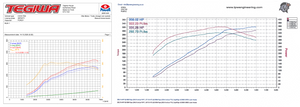
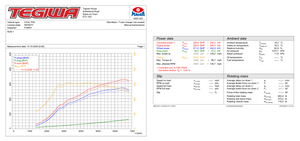
The dyno graphs show a baseline power figure of 315BHP, which matches the quoted stock output. With the Infinity Design intake fitted, peak power increases to 329BHP at 6,500RPM, representing a gain of 14BHP, alongside an increase of 15ft-lb of torque.
More importantly, the dyno results show improvements in both power and torque across the RPM range, rather than just an increase at peak power. This means the gains are not limited to the top end of the rev range, but are also present in the RPM range most commonly used during everyday driving.
These improvements are a result of the intake's ability to improve airflow to the engine and reduce restrictions compared to the standard intake system, helping the engine breathe more efficiently throughout the rev range.
Tuned Dyno Results
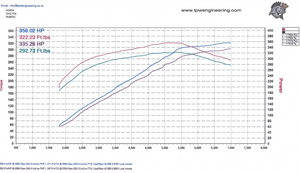
On the tuned car, the performance gains are even more significant. The dyno results follow the same trend, with improvements in both power and torque across the RPM range, rather than being limited to peak output.
The largest increase is 28BHP at 5,400RPM, demonstrating the benefits of improved airflow under higher engine loads. Peak power increases from 335BHP with the standard intake to 356BHP with the Infinity Design intake, a gain of 21BHP, along with an increase of 30ft-lb of torque.
This is achieved through the use of a large air filter and high volume airbox, providing greater airflow capacity. As the filter collects dirt and debris over time, its restriction increases, making filter size and available surface area even more important. A smaller filter is likely to become more restrictive as it gets clogged, resulting in a greater loss of power.
These results highlight how the factory intake can become an increasingly significant restriction as airflow demands rise with engine tuning.
Data Logging
The car used for data logging was completely standard, with no engine modifications. ECUTEK was used to log engine parameters on the dyno with both the factory and Infinity Design intakes fitted.
The data logged included wastegate duty cycle, intake air temperatures measured in the inlet manifold, ignition timing, air-fuel ratio and boost pressure.
Wastegate Duty Cycle
The wastegate duty data logs show that the Infinity Design intake generally operates with 1–2% lower wastegate duty cycle than the stock intake up to 5,000RPM. Above this point, the difference increases, with wastegate duty cycle reducing by approximately 4% compared to the factory intake through to redline.
Boost Pressure and Intake Temperatures
The manifold boost pressure logs show that the Infinity Design intake produces higher boost pressure throughout the run, and reaches the ECU's 1.5 bar boost limit 500RPM earlier from 5,900RPM compared to 6,400RPM. This is despite the lower wastegate duty cycle with the intake fitted, which shows that the improved airflow is reducing the work required from the turbo, therefore increasing the efficiency it's efficiency.
The manifold intake air temperatures are also 2–4°C lower with the Infinity Design intake fitted, contributing to the higher boost produced due to the increased air density at lower temperatures.
Ignition Timing and Air Fuel Ratio
The ignition timing data shows very little difference between the factory and Infinity Design intakes from 2,500RPM to 5,000RPM. Above 5,000RPM, however, the Infinity Design intake allows the ECU to advance ignition timing further. At 6,700RPM, the Infinity Design intake runs 2.5 degrees more ignition timing than stock.
This is reflected in the dyno results from the TPW-tuned car, where the performance gains become more pronounced above 5,400RPM. The ECU allows the engine to run higher ignition timing due to the lower intake temperatures, and explains the increased power and torque produced in the upper rev range.
The air-fuel ratio data follows a similar trend, with almost identical readings between the two intakes from 2,500RPM to 5,000RPM. Above this point, the Infinity Design intake runs slightly leaner, with a maximum difference of around 0.5 AFR. Despite this, the mixture remains comfortably richer than stoichiometric under load, showing that the increased airflow does not result in the engine running excessively lean. The ECU continues to maintain the richer air-fuel ratios required under high load.